
L’une des meilleures pratiques que nous recommandons est l’horodatage des déclarations de confidentialité et nous vérifions cela dans notre audit sur la confiance
en ligne.
Cet horodatage doit être visible en haut de page. C’est une question de transparence. De cette façon, les lecteurs
savent quand la déclaration a été mise à jour pour la dernière fois. Cette pratique doit être associée à une autre
pratique, l’accès aux versions précédentes de la déclaration de confidentialité,
qui n’est malheureusement proposé que par 3 % des sites. Les lecteurs ont ainsi la possibilité de savoir
ce qui a changé entre les versions et quand ces changements sont survenus.
Pour la première fois cette année, nous avons obtenu la date et l’heure de publication réelle
de plus de 1 000 déclarations de confidentialité de plusieurs secteurs audités, et
bien que nous ayons fait quelques commentaires de haut niveau dans l’audit, nous avons pensé qu’il serait
plus judicieux de fournir des informations encore plus détaillées. Une des raisons pour lesquelles
nous avons relevé les dates spécifiques est que de nombreuses déclarations de confidentialité ont été mises à jour
au cours du mois précédant (ou peu après) le 25 mai 2018, date
d’entrée en vigueur du Règlement général sur la protection des données (RGPD) dans l’Union européenne.
Le graphique ci-dessous montre les horodatages classés des plus récents au moins récents (se terminant par les déclarations non horodatées) de tous les secteurs audités. Les barres vertes représentent les déclarations de confidentialité comportant des horodatages depuis le début de 2018, les barres bleues représentent les horodatages antérieurs à 2018 et la barre grise représente celles qui ne comportent pas d’horodatage. Il convient de relever que ces données ont été collectées en février 2019, ce qui laissait assez de temps pour mettre à jour les déclarations de confidentialité. Dans l’ensemble, les déclarations de confidentialité de sites de près de 70 % des sites possèdent un horodatage – 46 % sont indiqués en haut de page, 22 % en bas de page et 2 % en haut et en bas.
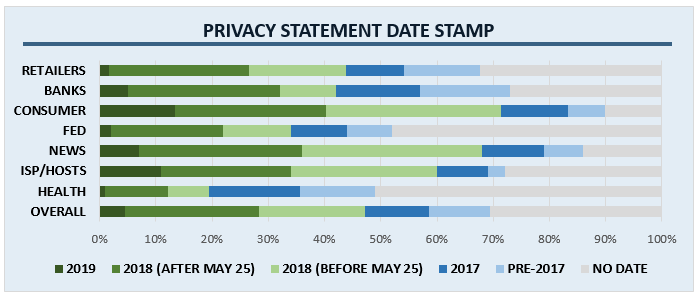
Il existe cependant un contraste au niveau de la période de publication des déclarations
de confidentialité. Les sites marchands sont en tête avec plus de 70 % des déclarations
horodatées du ou après le 1er janvier 2018. En revanche, moins de 20 % des sites de santé présentaient
des horodatages similaires. Ce même contraste est visible dans le pourcentage de sites comportant
une déclaration de confidentialité horodatée. Les sites de marchands sont ceux
qui arrivent en tête avec 10 % qui ne comportent pas d’horodatage, tandis que 50 % des sites de santé proposent des déclarations de confidentialité
sans date, ni heure de publication, ce qui tire tous les autres secteurs vers le bas.
Il convient de noter qu’un horodatage récent ne garantit pas
qu’une déclaration de confidentialité est meilleure et nous ne recommandons pas
d’actualiser les dates et heures de publication des déclarations de confidentialité régulièrement, juste pour donner l’impression
qu’elles sont à jour. L’évolution de la réglementation dans le monde et dans de nombreux états aux États-Unis
(par exemple, le RGPD et la California Consumer Privacy Act, qui entre
en vigueur en janvier 2020) incitent à modifier la plupart des déclarations de confidentialité,
rendant l’obsolescence des anciens horodatages de plus en plus manifeste. De même, les déclarations de confidentialité
sans horodatage poussent le lecteur à se demander si les récents changements relatifs
au respect de la vie privée ont été incorporés. Quoi qu’il en soit, soyez
sûrs que les régulateurs observent ce qu’il se passe.
Nous exhortons les organisations à adopter une approche plus stricte concernant leurs déclarations de confidentialité, à les examiner régulièrement pour incorporer des mises à jour nécessaires, à mettre à jour l’horodatage lorsque des modifications sont apportées et à fournir aux lecteurs un moyen de déterminer ce qui a changé. Cette transparence permet à tout le monde, collègues, consommateurs et régulateurs, de rester en phase et nous maintient à flot dans le secteur de la vie privée qui évolue rapidement.
How would your organization do in the Online Trust Audit? Check out the Best Practice Checklist (Appendix E) and use it to improve your site’s security and privacy.
The post Comment juger qu’une déclaration de confidentialité n’est pas obsolète ? appeared first on Internet Society.