
If you want to know more, you can see the presentation on the right (translated to English) and the video below (in catalan), which we made for the Encryption Day 2025 on 21 October.

Digital identity: towards a safer model under our control
In today’s digital world, proving who we are is much more complicated than it seems. Every time we create an account—at the bank, on social networks, in public services or even in an online shop—we generate small fragments of our digital identity. These pieces end up scattered across dozens of different services, often without us having any real control over them. And this raises risks: loss of privacy, dependence on large platforms and difficulties in securely and quickly proving basic information.
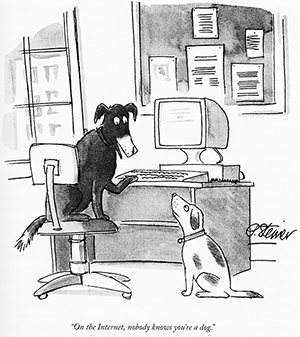
“On the Internet, nobody knows you’re a dog” is an adage and meme about anonymity on the Internet that began as the caption of a cartoon drawn by Peter Steiner and published by The New Yorker in 1993. How the world has changed!
The network has changed: we now live on an Internet devoted to profiling and collecting data about everyone and everything we do. Now we have gone to the other extreme. We live with screens all around us… and yet digital technology can also help us avoid obstacles…
New models of digital identity have emerged based on decentralised principles. Some are proprietary, others interoperable. The same people behind the web (the World Wide Web Consortium), the ones behind URLs such as “https://isoc.cat”, have proposed the concept of Decentralized Identity (DID), which allows each person to have their own verifiable identifier without depending on a centralised provider. This identifier, which for example can be associated with your web domain, acts as your independent “digital identity card”.
For example, our association can have the following DID: did:web:isoc.cat.
This means that the digital identity is linked to the isoc.cat domain and can be verified openly and securely through public files on the website itself. It is simple, interoperable and does not depend on any major platform.
On top of this identity, verifiable credentials can be built: digitally signed documents that you can store in your digital wallet and present when necessary. They are like physical cards, but much more secure, harder to forge and with far more privacy: you only disclose the strictly necessary information.
Let’s imagine a verifiable ISOC.CAT membership credential:
- Issuer: ISOC.CAT
- Holder: the member
- Attributes: name, membership number, date of joining
- Cryptographically verifiable by third parties
- Stored and managed on a persona digital wallet (on your mobile phone or web service).

As ISOC.CAT member you receive a card like this.
With such a credential, a member can prove their belonging to the association without having to send copies of documents or rely on easily forged paper. It would be enough to share a QR code or present a signed digital document that any verifying entity could automatically check, granting us immediate access to a website or a physical venue.
Until now, Europe has mainly relied on traditional digital certificates regulated by eIDAS1, such as those offered by the Open Administration of Catalonia and most if not all EU country governments. Although this technology is secure, it is rigid and not very flexible when it comes to managing multiple identities and credentials. This is why the European Union approved last year (2024) the new eIDAS2 regulation, which will be deployed progressively until the second half of 2026 and which is based precisely on decentralised identifiers and verifiable credentials to create a more usable, portable and citizen-controlled European digital identity.
This is the direction in which the digital identity ecosystem is moving: a model where we regain control of our data, where who we are and what we can prove depends on us, not on centralised platforms. At the chapter we have collaborated with the free software project IDHub to generate a decentralised identifier and a membership card or credential for each chapter member as an experiment to understand the concept.
L’entrada Identity and Credentials: the ISOC.CAT Membership Card ha aparegut primer a Capítol Català de la Societat Internet.