Global Internet freedom declined for the ninth consecutive
year in 2019, largely as a result of social media increasingly being used by
governments around the world as a conduit for mass surveillance and electoral
manipulation. The Freedom on the Net 2019 report, the
latest edition of the annual country-by-country assessment of Internet freedom,
was released on November 5 by Freedom House,
and highlights the shift in social media from a level playing field for civic
discussion to an instrument of political distortion and societal control.
The Freedom on the Net 2019 report analyzed Internet freedom in 65 countries worldwide, covering 87% of global Internet users. Surveyed countries are designated as ‘Free’, ‘Partly Free’, or ‘Not Free’ based on an examination of, and scoring against, three categories: obstacles to access, limits on content, and violations of user rights.
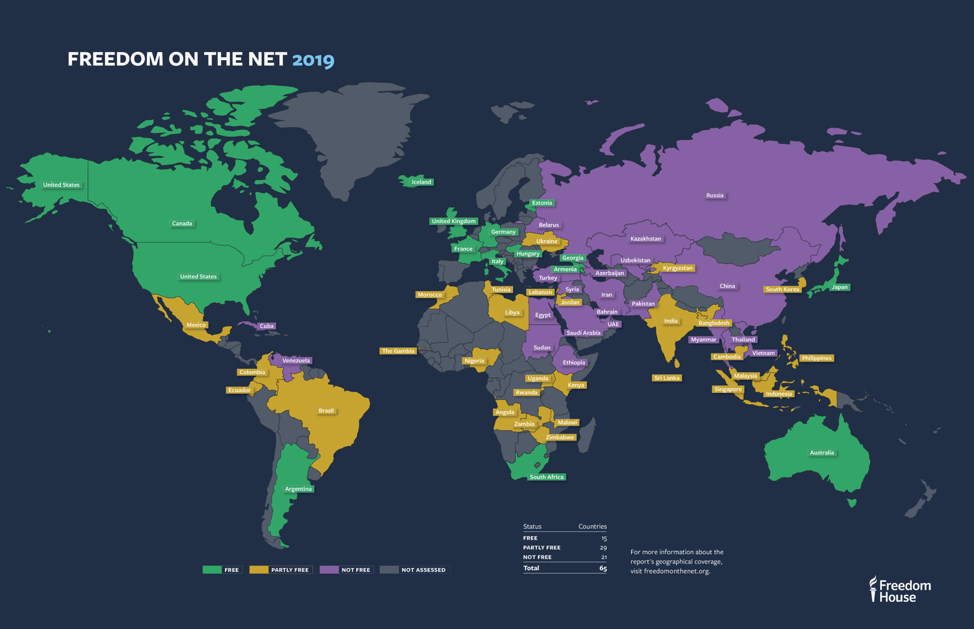
Of the 65 countries assessed, 33 of them saw Internet
freedom decline over the last year, with the biggest drops observed in Sudan
and Kazakhstan. The longtime presidents of both countries were ousted, leading
to widespread blocking of social media platforms, disruptions of Internet
connectivity, and the increased use of electronic surveillance to undermine
free expression.
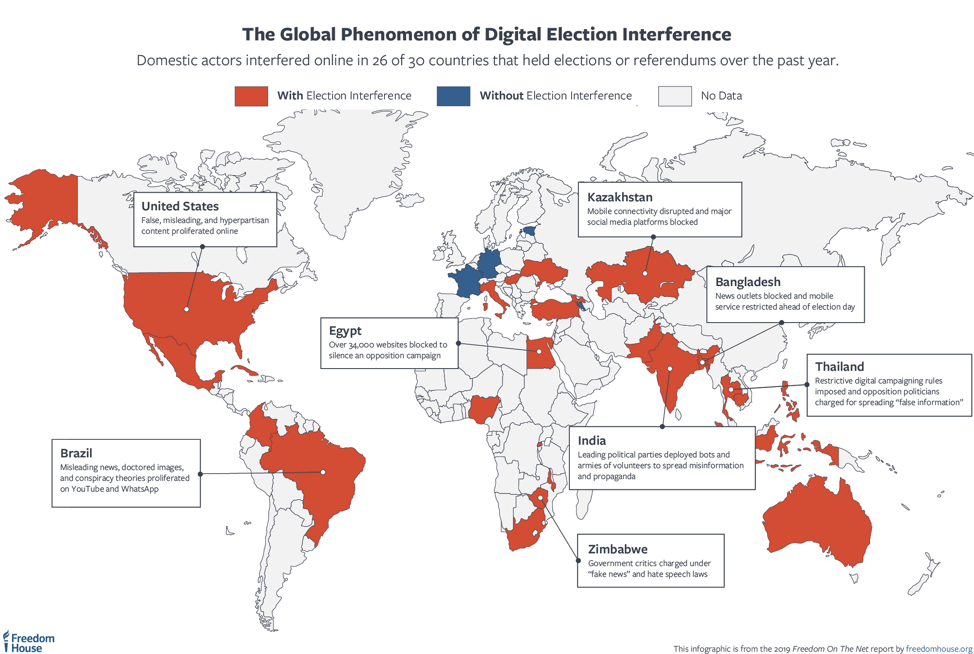
The report called digital platforms “the new battleground for democracy,” finding evidence of digital election interference in 26 of the 30 countries studied that held national votes over the last year. It notes that Internet freedom restrictions tend to escalate before and during crucial votes, and that digital election interference was found to have taken three forms: informational measures (surreptitious manipulation of online discussions), technical measures (including access restrictions), and legal measures (to punish opponents and limit political expression).
Freedom House’s analysis also found that Internet freedom in
the United States declined for the third straight year. Although it highlighted
that the online environment within the country continues to remain vibrant,
diverse, and free from state censorship, the report also called out a number of
factors that drove the Internet freedom score lower, ranking the U.S. seventh
globally. These included:
- Expanded surveillance of the public by law
enforcement and immigration agencies, with limited oversight or transparency. - Increased monitoring of social media platforms.
- Disinformation around major political events,
with both foreign and domestic actors manipulating content for political
purposes.
As noted above, connectivity/access restrictions and Web
site/application blocking have become increasingly popular tactics. This year’s
report found that social media and communications applications were blocked in
at least 20 surveyed countries. Internet connectivity didn’t fare much better,
with telecommunications networks suspended in 17 surveyed countries. These
actions often occurred ahead of elections or during periods of protest and
civil unrest. Unfortunately, this remains an ongoing issue, as cited in our
summary of the Freedom on the Net 2017
report.
Despite the declines in Internet freedom and their
underlying causes highlighted in the report, the news was not all bad this
year. Freedom House found that 16 surveyed countries earned improvements in
their Internet freedom scores, with the greatest gain seen in Ethiopia. While
network shutdowns unfortunately continued to occur in the country, they were
more temporary and localized than previous nationwide shutdowns. In addition,
the new Prime Minister’s government loosened restrictions on the Internet,
unblocking over 250 Web sites, and also reduced the number of people imprisoned
for online activity.
Malaysia and Armenia were also specifically called out for
their positive progress, and Iceland was listed as the “world’s best protector
of Internet freedom”, with the report stating “The country boasts enviable
conditions, including near-universal connectivity, limited restrictions on
content, and strong protections for users’ rights.”
How you can get involved:
- Read the full
Freedom on the Net 2019 report to
gain deeper insight into this year’s findings. - Attend the Freedom on the Net 2019 launch event
on November 12 for a discussion of key findings and emerging trends in Internet
freedom, including the shifting methods used by governments to manipulate
elections and monitor citizens on social media. - Review the country-level rankings to understand
the key Internet controls employed in your country, and other countries of
interest. - Use the recommendations within the report as
guidance for outreach to local policymakers, initiatives within the private
sector, and participation in civil society activities. - Follow organizations including Freedom House (@freedomhouse) and the Internet
Society (@internetsociety)
on social media to stay up-to-date on issues concerning Internet freedom around
the world.
The Internet Society is a proud supporter of
Freedom House and the Freedom on the Net initiative because their work aligns
closely with our goals for the Internet to be open, globally-connected, secure,
and trustworthy.
The post Social Media Crisis Drives Ongoing Decline In Global Internet Freedom appeared first on Internet Society.